

Affiliate disclosure: As an Amazon Associate I earn from qualifying purchases. Amazon links in this guide are paid affiliate links. ProductPicks may earn a commission at no additional cost to you.
Research checked: 2 November 2026. This is an editorial shortlist based on manufacturer specifications and attributed hands-on reviews, not ProductPicks camera testing. We could not verify live Amazon checkout prices, sellers or stock. Prices described as buying targets below are our recommendations—not available offers or a claim to have found the cheapest phone on Amazon.
Finding a good budget camera phone in India means deciding what you actually photograph. A sharp everyday main camera, dependable video and useful optical zoom are different requirements. The least expensive phone with a 50MP label is not automatically the best-value camera purchase.
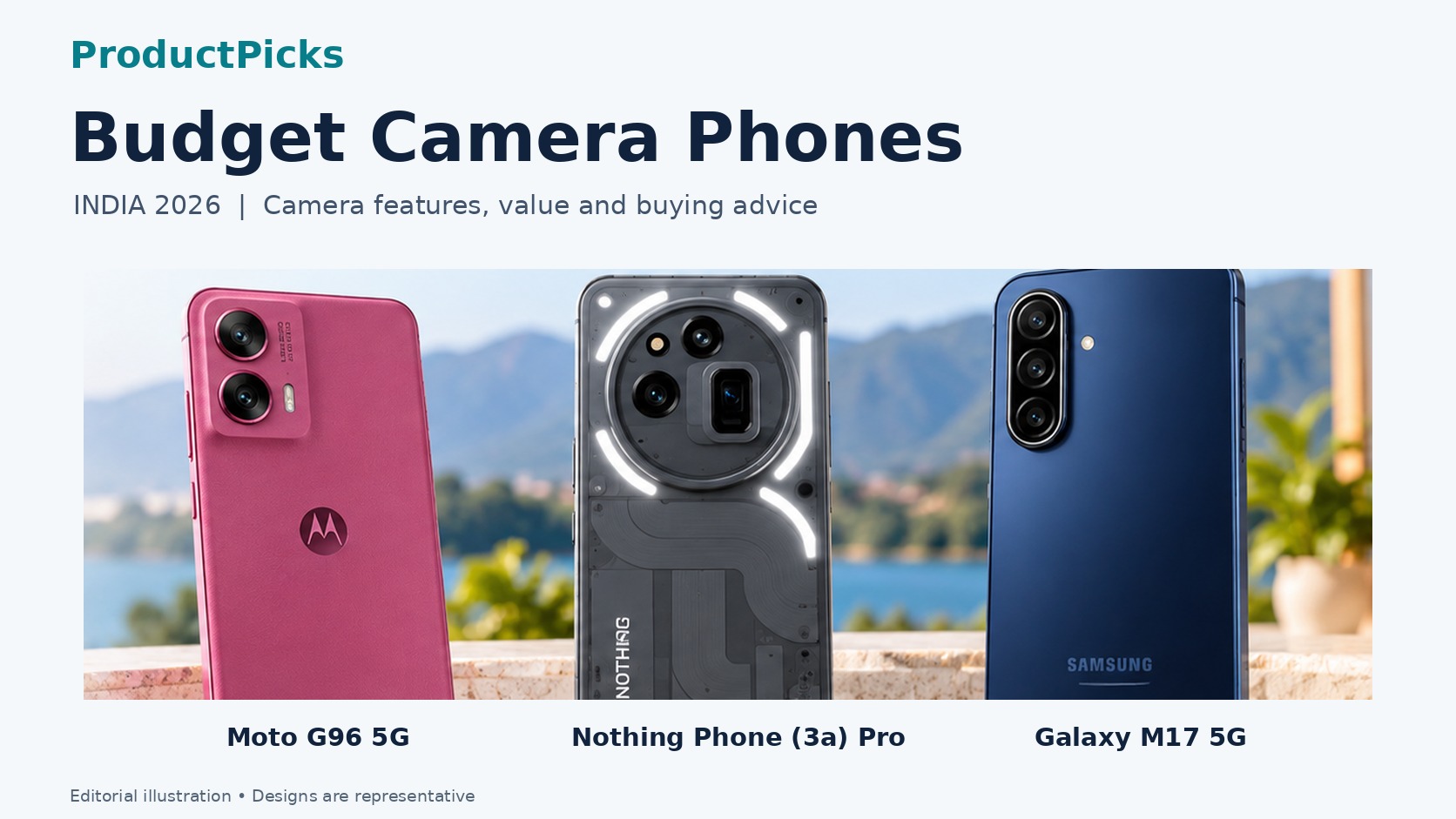
This guide compares the Moto G96 5G, Nothing Phone (3a) Pro and Samsung Galaxy M17 5G. They are three candidates worth evaluating at the right prices, not an exhaustive ranking of every current smartphone. We also explain why replacing an older premium phone may not improve your photographs.
Quick verdict: which phone should you shortlist?
Moto G96 5G is our lower-cost starting point, provided a trustworthy offer is around ₹20,000 or less. Its main-camera hardware and video options make it worth examining for everyday photography. Do not stretch the budget for an inflated marketplace listing simply because it appears in a budget-phone guide.
Nothing Phone (3a) Pro is the step-up choice when you want an additional shooting option. Its dedicated 3× telephoto camera is the main reason to investigate it around ₹28,000. That is a target price, not confirmation of an available ₹27,999 deal, and the extra camera does not guarantee better pictures in every situation.
Galaxy M17 is the conditional lower-price alternative. It is more attractive when substantially cheaper than the G96 or when software support matters more than video resolution. At a similar asking price, we would not choose it solely because it has three rear cameras. The evidence and limitations behind these judgements follow below.
Camera specifications compared
| Feature | Moto G96 5G | Nothing Phone (3a) Pro | Galaxy M17 5G |
|---|---|---|---|
| Main camera | 50MP Sony LYTIA 700C with OIS | 50MP with OIS | 50MP with OIS |
| Ultrawide | 8MP with autofocus and macro capability | 8MP | 5MP |
| Additional rear camera | No dedicated telephoto | 50MP OIS periscope, 3× optical zoom | 2MP macro; no dedicated telephoto |
| Selfie camera | 32MP | 50MP | 13MP |
| Video capability | 4K/30fps on main, ultrawide and front cameras | 4K/30fps on main and front; telephoto support added by software update | Up to 1080p/30fps |
| Main buying question | Is the price low enough for its overall compromises? | Will you actually use the 3× camera? | Is the saving worth the video and low-light limitations? |
Specification sources: Motorola’s G96 specification sheet, Nothing’s official product page, Nothing’s telephoto-video update and Samsung’s M17 specifications. OIS means optical image stabilisation. Supported resolution is not a measured image-quality score; lens switching and stabilisation modes can have restrictions.
1. Moto G96 5G: our affordable camera-first starting point
The G96 combines a stabilised main camera with an ultrawide that can also focus close. That is a useful set of options for travel scenes, food, family photographs and occasional video without paying specifically for a telephoto camera. Motorola documents its camera and recording features; these specifications support the shortlist, but cannot establish how every shot will turn out.
In its hands-on review, 91mobiles found good main-camera detail and dynamic range, with colourful processing. It also reported difficulty controlling bright light sources at night and softer, noisier ultrawide images in low light. Its review was published in July 2025 and updated in August 2025, so those findings describe the tested software, not a November 2026 retest.
Our buying rule: start around ₹20,000 or below for a new Indian-market unit with acceptable warranty and seller terms. Above that, reopen the comparison rather than treating this recommendation as unconditional. A more expensive 256GB variant is not directly comparable with a discounted 128GB offer.
The important non-camera compromise is software longevity. Motorola’s specification sheet lists one major OS upgrade and three years of security maintenance; its India security-support page should be checked for the exact device. Do not assume a fresh three-year period begins when you buy old stock.
Best fit: a buyer replacing a weak basic camera phone at a controlled budget. Less convincing: someone seeking a clear improvement over an already capable premium phone, or who values a long remaining update period above everything else.
Compare Moto G96 5G listings on Amazon India — paid model search; verify RAM, storage, condition and seller.
2. Nothing Phone (3a) Pro: more camera versatility, not a guaranteed winner
The reason to pay more for the Nothing is its separate 3× periscope camera, rather than merely the word “Pro.” It provides a longer optical viewpoint than the main camera. Nothing’s official camera description distinguishes that optical option from its much larger digital-zoom claims. Do not read a 60× maximum as 60× optical zoom.
The 91mobiles review praised the phone’s daylight, selfie and low-light photography, but criticised telephoto detail and some portrait-edge detection. That March 2025 review, updated in May, is useful evidence—not proof of permanent behaviour after every update. We would shortlist the phone for its extra framing option, not declare it the best portrait camera at any price.
A software change worth knowing about
Nothing’s official OS 3.1 changelog added 4K recording to the telephoto camera. Consequently, launch reviews saying that only the main and front cameras support 4K do not describe the updated feature set. Install the current stable software and check the available lens and video modes on the actual phone.
Our buying rule: investigate an 8GB/128GB unit around ₹28,000, with enough budget left for any necessary charger or accessories. The earlier ₹27,999 figure should be treated as a lead to check, not a live offer. If the price rises beyond your budget, this article is not a reason to overspend.
Nothing’s published product documentation describes three years of Android updates and six years of security support, measured from the product’s initial availability. Confirm the applicable India support and box contents. The reviewed package did not include a charger.
Best fit: a buyer who deliberately wants a telephoto option and will use it regularly. Less convincing: someone taking almost every picture at 1× and expecting the higher price alone to guarantee better results.
Compare Nothing Phone (3a) Pro listings on Amazon India — paid model search; distinguish it from the regular Phone (3a).
3. Samsung Galaxy M17 5G: a conditional budget alternative
The M17 has OIS on its main camera, but Samsung’s official specification limits recording to Full HD at 30fps. Buyers specifically wanting 4K should not assume that a modern Samsung phone or a triple-camera layout provides it.
In its hands-on M17 review, 91mobiles liked natural-looking main-camera colours and outdoor detail, while reporting noise indoors and in low light. It also found limited ultrawide detail. The review dates from October 2025, updated in November 2025; we have not independently reproduced those results.
There is a separate reason to consider it: Samsung announced six generations of OS upgrades and six years of security updates. That can matter for long-term ownership, although an advertised support period is not extra camera performance and should not be assumed to restart with each purchase.
Our buying rule: consider it when the saving over a suitable G96 offer is meaningful, or when Samsung’s software commitment better matches your priorities. We would not automatically pay close to the G96’s target price for an M17 purely for photography. Compare the actual RAM variant too: a 4GB phone and an 8GB phone are not equivalent offers.
Best fit: ordinary daytime photos and longer-term general use at a genuinely lower cost. Less convincing: buyers focused on 4K recording, dim indoor photographs or dedicated optical zoom.
Compare Samsung Galaxy M17 5G listings on Amazon India — paid model search; inspect the selected RAM option and charger bundle.
What should you pay on Amazon?
| Phone | Our editorial buying condition | What still needs checking |
|---|---|---|
| Moto G96 5G | Around ₹20,000 or less as a starting ceiling | 128GB versus 256GB, current seller, invoice and remaining support |
| Nothing Phone (3a) Pro | Around ₹28,000 for the 8GB/128GB model | Exact Pro model, final non-exchange price and accessory cost |
| Galaxy M17 5G | Meaningfully cheaper than the G96, unless support is your priority | 4GB/6GB/8GB RAM, final price and charger contents |
These are decision thresholds, not a price tracker. During this research, the Amazon product pages attempted did not expose verifiable live checkout information. We have therefore used model-search links rather than claiming that a particular ASIN, seller or colour is the cheapest available option.
Compare like-for-like conditions: new versus renewed, storage capacity, India warranty, seller identity and delivery location. Treat exchange value, bank-card eligibility and conditional coupons separately from the normal price. A discount that requires trading in your existing phone is not the same as an unconditional saving.
How to compare camera phones without getting distracted by megapixels
Start with the pictures you take most often
For children, pets and family photographs indoors, inspect motion blur, skin tones and how quickly the camera captures a shot. For travel, compare the ultrawide as well as the main camera. For distant details or a different portrait viewpoint, inspect the telephoto. A beautiful landscape sample says little about a moving child under indoor lighting.
OIS helps with camera shake, not every kind of blur
Optical stabilisation can compensate for some hand movement, but it does not freeze a moving subject. A photograph can still blur if exposure is too long or focus misses. Compare actual samples rather than treating “OIS” as an assurance of sharp pictures in every situation.
Separate optical zoom from cropping and portrait effects
A dedicated telephoto camera offers a different optical view. Digital zoom crops or processes an image, while portrait background blur can also involve software. Examine fine detail, hair edges and skin texture at the zoom level you expect to use—not just the largest zoom number in an advert.
Check video samples, not only “4K” on the box
Look for stable walking footage, sensible exposure changes, clear audio and whether focus hunts. Resolution, frame rate, available lenses and stabilisation may vary by mode. Ask for samples from the current firmware where possible, and do not merge three reviewers’ unrelated test conditions into a supposedly measured league table.
Already own a capable phone such as the OnePlus 11R?
A new purchase and a camera upgrade are different decisions. The OnePlus 11R’s official specifications already include rear 4K recording at 60fps. Buying a phone whose cited recording mode tops out at 4K/30fps is not automatically a video upgrade, even if it is newer.
For an 11R owner, our advice would be to keep a healthy phone unless there is a clearly demonstrated benefit in the photographs you care about. Nothing’s extra telephoto option is a new capability to investigate, but not proof that its main camera beats the older phone in every scene. No controlled head-to-head test establishing an overall 11R upgrade is presented here.
Before buying: a practical camera-phone check
Check the exact item. Confirm model, RAM, storage, new or renewed condition, Indian invoice and warranty. Read the seller’s replacement conditions; do not assume a phone can be returned simply because you dislike its photographs.
Budget for ownership. Check charger inclusion, compatible charging support, storage needs and the remaining security-update period. The M17 and Nothing review packages cited above lacked chargers; a seller may offer a different bundle, so inspect the box contents rather than assuming.
Judge samples carefully. Look at full-size photographs, faces in your usual lighting, indoor movement and short video clips. Review the whole image rather than assuming a brightly coloured social-media thumbnail proves better detail. Camera updates can change processing, so note the review date and software version.
Frequently asked questions
Which is the cheapest good camera phone on Amazon?
This research does not establish a live cheapest listing. Our starting candidate is the G96 at around ₹20,000 or less; the M17 is a lower-price alternative only when its actual offer and compromises make sense. Compare current offers rather than treating those targets as in-stock deals.
Is the Nothing Phone (3a) Pro worth the extra money?
It is worth investigating when you specifically want the longer optical viewpoint. Buyers who mostly shoot at 1× should compare main-camera samples before paying more. A useful extra lens and a universally better camera are not the same claim.
Are these three the best camera phones across the entire 2026 market?
No. They are the three-model shortlist examined in this guide. Other phones or changing discounts can offer better value. Reconsider the options when the actual prices move outside the conditions described above.
Does having three rear cameras beat having two?
Not necessarily. The extra camera’s purpose and output matter more than the count. Check whether it gives you a genuinely useful shooting option and whether you like the resulting photographs.
Final verdict
Start with the Moto G96 for a controlled-budget camera purchase; consider the Nothing Phone (3a) Pro when you deliberately want more lens versatility; choose the Galaxy M17 only when its price or ownership advantages justify the camera compromises. Those recommendations are conditional on the exact offer, not claims of a verified cheapest Amazon price.
For anyone already using a capable phone, the cheapest sensible decision may be not replacing it yet. Spend only when the new device solves a real limitation you have identified.
Related ProductPicks guides: 65W GaN chargers for laptops and phones and wireless earbuds under ₹3,000.
Sources and research notes
Specifications and updates: Motorola’s linked G96 documentation and India security schedule; Nothing’s official product information and telephoto-video changelog; Samsung’s M17 specifications and launch support commitment; OnePlus’s 11R specification page. Image-quality evidence: the linked 91mobiles hands-on reviews, with their 2025 dates identified above. These are separate reviews, not a single controlled three-phone shootout.
Editorial buying thresholds are ProductPicks’ judgement. Live Amazon prices, availability and seller eligibility were not verified. All three Amazon searches include tracking tag productpicks-in-21. No ProductPicks hands-on testing, fabricated camera score or guaranteed upgrade is implied.
[…] ProductPicks reading: our budget camera smartphones in India comparison examines a different kind of camera […]